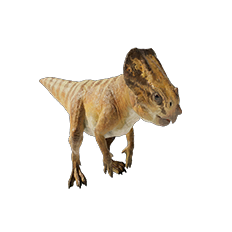
Aquilops
Size
| Size | Small |
|---|---|
| Height (m) | 0.2 |
| Length (m) | 0.55 |
| Weight (kg) | 2 |
Classification
| Diet | Ground Paleobotany |
|---|---|
| Habitat | Terrestrial |
| Era | Early Cretaceous |
| Family | Ceratopsia |
| Genus | Aquilops |
| Bio Group | Small Herbivore |
Rating
| Base Appeal | 34 |
|---|---|
| Appeal (Per Hectare) | 265.1 |
| Base Dominance | 16 |

Stats
| Lifespan | 29 - 58 |
|---|---|
| Resilience | 130 |
| Attack | 8 |
| Defence | 8 |
| Medical Dart Resistance | 60 |
| Sedative Resistance | 60 |
| Poison Resistance | 40 |
| Appetite | 10 |
| Bite Size | 5 |
Security
| Security Rating |  |
|---|---|
| Threat | None |
| Dinosaur Send / Summon | Yes |
Environmental Needs
| Comfort | 50% / 70% / 90% | |
|---|---|---|
| Pasture (m2) | 1450 | 51% |
| Ground Nut (m2) | 400 | |
| Ground Fiber (m2) | 550 | |
| Water (m2) | 450 | |
Genome Trait Chances
| Genetic Mods (Max) | 8 | |
|---|---|---|
| Resilience | 50% | Resilient |
| Sociability | 25% | Social |
| Habituation | 8% | Docile |
| Nocturnal | 8% | Nocturnal |
| Skittish | 25% | Skittish |
| Fitness | 25% | Fit |
Unlock requirements
Unlocked by retrieving the fossil from one of the following dig sites:
| Dig Sites | Locations | Fossils | Requirements (Logistics) | Duration | Cost |
|---|---|---|---|---|---|
| Carbon County | North America ┗ USA ┗ Montana |  x4  x3  x3 | 5 | 4m 20s | $257,000 |
Synthesis
| Eggs | 2 - 3 |
|---|---|
| Requirements (Genetics) | 3 |
| Scientists (Max) | 5 |
| Duration | 25s |
| Cost | $45,000 |
| Cost (Genetic Mods) | $2,000 |
Incubation
| Requirements (Welfare) | 5 |
|---|---|
| Scientists (Max) | 5 |
| Duration | 1m 45s |
| Cost | $23,000 |
Breeding
Disease
| Immune | Bracken Poisoning |
|---|---|
| Susceptible | Hookworms |
Description
A relatively small herbivore, the Aquilops is an Early Cretaceous ceratopsian whose fossils were first discovered in southern Montana. It gets its name, meaning “Eagle Face”, from its distinctive beaked snout which it uses to slice through and chew low-growing vegetation.
Discovery
While the first fossils of the Aquilops were discovered in 1997 by paleontologist Scott Madsen, the species was not formally described and named until 2014 by Andrew Farke. The find is significant to paleontology as the first basal ceratopsian found in North America. In the modern day, it was synthesized at a secretive facility located on Île Saint-Hubert which remains its only known territory.
Paleoecology
As a small ceratopsian, Aquilops were prey for many contemporary predators in their Early Cretaceous environment, including Velociraptor, Acrocanthosaurus, and Deinonychus. Modern observations of this animal are rare due its sole synthesis on a discreet island facility, but reports have described it as sociable and curious.


Cohabitation Preferences
Behaviors are scripted in game files but are not guaranteed to happen. Dominance, territory, and traits determine whether they would actually fight.