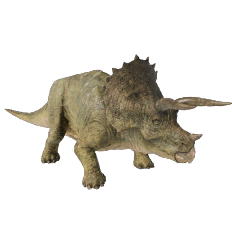
Triceratops
Size
| Size | Medium |
|---|---|
| Height (m) | 3.6 |
| Length (m) | 8.9 |
| Weight (kg) | 12,000 |
Classification
| Diet | Ground Paleobotany |
|---|---|
| Habitat | Terrestrial |
| Era | Late Cretaceous |
| Family | Ceratopsidae |
| Genus | Triceratops |
| Bio Group | Armored Herbivore |
Rating
| Base Appeal | 109 |
|---|---|
| Appeal (Per Hectare) | 361.2 |
| Base Dominance | 114 |

Stats
| Lifespan | 37 - 73 |
|---|---|
| Resilience | 130 |
| Attack | 76 |
| Defence | 38 |
| Medical Dart Resistance | 120 |
| Sedative Resistance | 120 |
| Poison Resistance | 100 |
| Appetite | 125 |
| Bite Size | 13 |
Security
| Security Rating |  |
|---|---|
| Threat | Ranger Team |
| Dinosaur Send / Summon | Yes |
Environmental Needs
| Comfort | 50% / 70% / 90% | |
|---|---|---|
| Cover (m2) | 963 | 19% |
| Wetland (m2) | 1023 | 20% |
| Ground Fiber (m2) | 2557 | |
| Water (m2) | 504 | |
Genome Trait Chances
| Genetic Mods (Max) | 12 | |
|---|---|---|
| Tolerance | 75% | Intolerant |
| Habituation | 8% | Docile |
| Aggression | 15% | Aggressive |
| Nocturnal | 6% | Nocturnal |
| Offence | 25% | Strong |
Unlock requirements
Unlocked by retrieving the fossil from one of the following dig sites:
| Dig Sites | Locations | Fossils | Requirements (Logistics) | Duration | Cost |
|---|---|---|---|---|---|
| Hell Creek Formation B | North America ┗ USA ┗ Montana |  x1  x1  x2 | 2 | 3m 30s | $136,000 |
| Lance Formation Site B | North America ┗ USA ┗ Wyoming | x2 x1 x1 | 2 | 3m 30s | $117,000 |
Synthesis
| Eggs | 1 - 4 |
|---|---|
| Requirements (Genetics) | 5 |
| Scientists (Max) | 5 |
| Duration | 1m 15s |
| Cost | $175,000 |
| Cost (Genetic Mods) | $8,750 |
Incubation
| Requirements (Welfare) | 5 |
|---|---|
| Scientists (Max) | 5 |
| Duration | 3m 45s |
| Cost | $175,000 |
Breeding
| Nest Size | Medium |
|---|---|
| Nest Location | Cohabitation |
| Breeding Archetype | Slow B |
| Eggs | 2 - 4 |
| Compatibility | 0% - 60% |
| Requirements (Welfare) | 4 |
| Duration | 1m 30s |
| Duration (Incubation) | 4m - 7m |
| Duration (Postpartum) | 1h 14m |
| Cost | $200,000 |
Disease
| Immune | None |
|---|---|
| Susceptible | Hookworms |
Description
The herbivorous dinosaur Triceratops is one of the largest ceratopsidae, at around 9m in length and weighing 12 tons. Notable for its large frill and the three horns on its head – which give rise to its name, which translates to ‘three-horned face – Triceratops’ diet consists mainly of ground level vegetation, although their size may have enabled them to knock over larger plants and trees to feed on.
Discovery
Triceratops was discovered in 1887, when George Lyman Cannon found a partial skull with two horns close to Denver, Colorado and sent the specimen to famous paleontologist Othniel Charles Marsh. The bones were initially considered to belong to a large bison but, two years later, Marsh realized that they belonged to a previously undiscovered genus of horned dinosaur, which he named Triceratops.
Paleoecology
This genus lived in the United States approximately 66-68m years ago during the Late Cretaceous period, roaming the forests and plains where food was easy to find. Numerous dinosaurs co-existed in Triceratops’ environment, including Torosaurus, Ankylosaurus and Stygimoloch, while Triceratops needed its horns to defend itself from predators including Tyrannosaurus.
Elsewhere on Paleo.GG
 Triceratops
 Triceratops Gen 2
 TRICERATOPS
 TRICERATOPS GEN 2
 Triceratops
 Triceratops
 Triceratops
 Triceratops
 Triceratops
 Triceratops
 Triceratops
 Triceratops (1/1)
 Triceratops (1/2)
 Triceratops (2/2)
 Triceratops (2/3)
 Triceratops (1/3)
 Triceratops (3/3)
 Triceratops (2/2)
 Triceratops (1/2)
 Triceratops
 Triceratops
 Triceratops
 Tricera
 Tricera
 Triceratops
 Triceratops
 Triceratops
Cohabitation Preferences
Behaviors are scripted in game files but are not guaranteed to happen. Dominance, territory, and traits determine whether they would actually fight.