Titanosaurus
Size
| Size | Large |
|---|---|
| Height (m) | 20 |
| Length (m) | 40 |
| Weight (kg) | 60,000 |
Classification
| Diet | Tall Paleobotany |
|---|---|
| Habitat | Terrestrial |
| Era | Late Cretaceous |
| Family | Titanosauria |
| Genus | Titanosaurus |
| Bio Group | Giant Herbivore |
Rating
| Base Appeal | 350 |
|---|---|
| Appeal (Per Hectare) | 281.7 |
| Base Dominance | 155 |

Stats
| Lifespan | 37 - 95 |
|---|---|
| Resilience | 130 |
| Attack | 75 |
| Defence | 80 |
| Medical Dart Resistance | 180 |
| Sedative Resistance | 180 |
| Poison Resistance | 250 |
| Appetite | 300 |
| Bite Size | 25 |
Security
| Security Rating |  |
|---|---|
| Threat | None |
| Dinosaur Send / Summon | Yes |
Environmental Needs
| Comfort | 50% / 70% / 90% | |
|---|---|---|
| Pasture (m2) | 2805 | 16% |
| Wetland (m2) | 5522 | 31% |
| Tall Leaf (m2) | 2521 | |
| Water (m2) | 3200 | |
Genome Trait Chances
| Genetic Mods (Max) | 12 | |
|---|---|---|
| Appetite | 25% | Large Appetite |
| Lifespan | 25% | Short Lived |
| Resilience | 50% | Resilient |
| Habituation | 8% | Docile |
| Nocturnal | 6% | Nocturnal |
| Fitness | 25% | Unfit |
Unlock requirements
Unlocked by retrieving the fossil from one of the following dig sites:
| Dig Sites | Locations | Fossils | Requirements (Logistics) | Duration | Cost |
|---|---|---|---|---|---|
| Lameta Formation | jwe3-digsite:india ┗ India ┗ Narmada Valley |  x4  x3  x2 | 8 | 7m | $300,000 |
Synthesis
| Eggs | 1 - 1 |
|---|---|
| Requirements (Genetics) | 6 |
| Scientists (Max) | 5 |
| Duration | 2m 25s |
| Cost | $449,000 |
| Cost (Genetic Mods) | $22,000 |
Incubation
| Requirements (Welfare) | 10 |
|---|---|
| Scientists (Max) | 5 |
| Duration | 6m |
| Cost | $299,000 |
Breeding
| Nest Size | Large |
|---|---|
| Nest Location | Consolidation |
| Breeding Archetype | Average A |
| Eggs | 2 - 3 |
| Compatibility | 0% - 50% |
| Requirements (Welfare) | 6 |
| Duration | 2m |
| Duration (Incubation) | 3m - 5m |
| Duration (Postpartum) | 1h 31m:40s |
| Cost | $300,000 |
Disease
| Immune | Common Cold |
|---|---|
| Susceptible | Bracken Poisoning |
Description
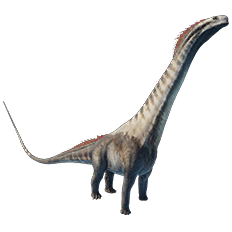
Among the last giant sauropods to walk the earth in the Late Cretaceous, the humungous Titanosaurus was created in the modern day on a secretive island research facility. Besides its remarkable size amongst de-extinct animals, it features several unusual characteristics amongst sauropods: namely, a long and whip-like tail, and two sets of short sails along its spine.
Discovery
Fossils of the Titanosaurus were first discovered in 1828 in India by Captain William Henry Sleeman who considered them curiosities. The bones were passed between various experts for roughly fifty years after this, but it was Richard Lydekker in 1877 that truly described and identified those bones as the remains of a previously unknown species. The Titanosaurus holds the honor of being the first Indian dinosaur to ever be named.
Paleoecology
The Late Cretaceous environment that the Titanosaurus evolved into was diverse in both flora and fauna but was also a hotbed volcanic activity. Due to various eruptions at the time, it’s believed that most Late Cretaceous dinosaurs in this environment went extinct long before the Cretaceous-Paleogene mass extinction event that killed most other dinosaur species. Little is known of the paleoecology of modern Titanosaurus due to their sole synthesis at a classified research laboratory. The few reports that have been made describe them as social and peaceful animals, tolerant of smaller species in their territory.


Cohabitation Preferences
Behaviors are scripted in game files but are not guaranteed to happen. Dominance, territory, and traits determine whether they would actually fight.